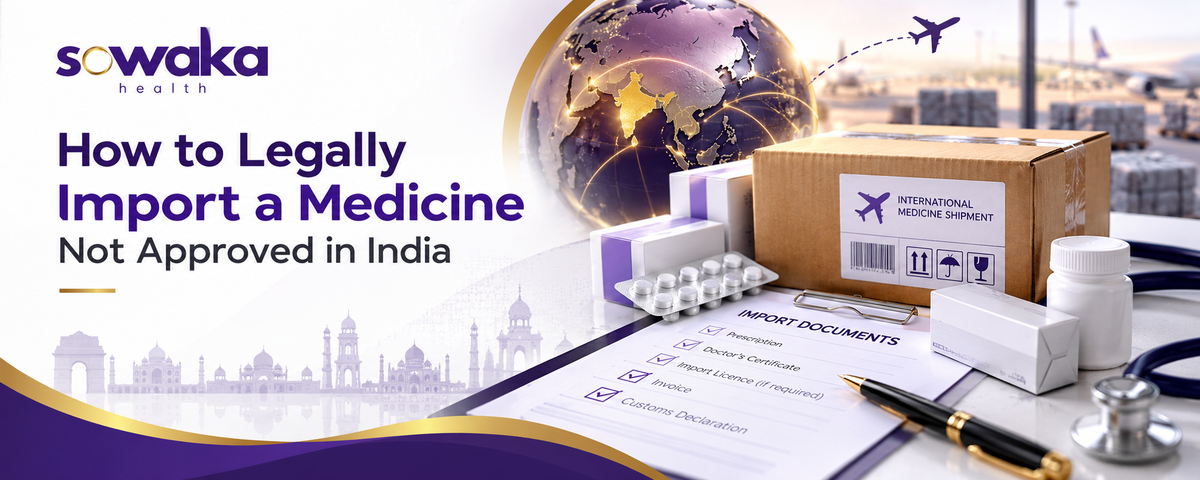
Finding out that a medicine prescribed by your doctor is not approved or commercially available in India can be confusing. The next question is usually simple: Can the medicine be legally brought into India for the patient who needs it?
In some circumstances, Indian regulations allow medicines that are otherwise not permitted for commercial import to be imported in small quantities for personal use. However, this does not mean that a patient can simply order the medicine from another country and have it shipped to India.
The route depends on the medicine, the quantity, the purpose of import and the applicable provisions under Rule 36.
Important disclaimer: This article is for general information only and does not replace advice from a treating physician, the Central Drugs Standard Control Organisation (CDSCO), Customs authorities or a qualified regulatory professional. Requirements are governed by the applicable Rule 36 provisions and may differ depending on the medicine, quantity and route of import.
Can you legally import a medicine that is not approved in India?
In certain circumstances, yes.
India’s Drugs and Cosmetics Rules, 1945 provide a mechanism for imports of drugs for personal use. Rule 36 addresses personal-use imports, including medicines that would otherwise be prohibited from import under the applicable provisions.
The important point is that “not approved in India" does not automatically mean “cannot be imported under any circumstances.”
The relevant route depends on whether the medicine is carried as bona fide personal baggage or imported separately, and whether the licensing authority is satisfied that the import is for bona fide personal use.
For example, when a medicine is imported for personal use but is not part of a passenger’s bona fide baggage, Rule 36 provides that an application may be made in Form 12A and, where the conditions are satisfied, the licensing authority may grant permission in Form 12B. The quantity must be reasonable in the opinion of the licensing authority and covered by a prescription from a registered medical practitioner.
What is the legal process for importing a medicine not approved in India?
For a patient who has been prescribed a medicine that is not approved or commercially available in India, the process generally involves more than purchasing the medicine overseas or arranging an international shipment.
A typical personal-use import should be checked against the applicable route under Rule 36, including whether the medicine is being carried as bona fide personal baggage or imported separately through the Form 12A/Form 12B permit process.
1. Confirm the prescription and medical need
The starting point should be the patient’s treating physician. The prescription should identify the medicine, the quantity required and the medical basis for use, and should be issued by a registered medical practitioner with the relevant registration details.
2. Identify whether baggage or permit rules apply
Not every personal-use import follows the same route. If the medicine forms part of a passenger’s bona fide baggage and is for that passenger’s exclusive personal use, Rule 36 includes conditions on declaration to Customs where directed and quantity.
The rules refer to a limit of 100 average doses for any single drug unless a larger quantity is sanctioned in an exceptional case.
If the medicine is not part of bona fide personal baggage, the applicant may need to apply in Form 12A, and the licensing authority must be satisfied that the drug is for bona fide personal use before granting permission in Form 12B.
This article covers personal-use imports. Hospital or commercial bulk imports are outside the scope of this guide and are subject to separate regulatory requirements.
3. Prepare the application, permit and shipment documents
Depending on the applicable route and medicine, documentation may include the prescription, patient information, medicine and quantity details, Form 12A where applicable, the Form 12B permit or other import permission where required, supplier or manufacturer documents, authorization documents if another person is collecting the consignment, invoice or shipment documentation, and customs documentation.
What is Form 12A?
Form 12A is an application for a permit to import small quantities of drugs for personal use.
The Form 12A process asks for patient details, medicine and quantity details, identity documents and supporting documents, including a prescription from a registered medical practitioner.
Submitting Form 12A is not the same as receiving permission to import. The licensing authority must consider whether the medicine is for bona fide personal use and whether the requested quantity is reasonable before issuing permission in Form 12B.
What is Form 12B?
Form 12B is the permit for importing small quantities of drugs for personal use when the Form 12A route applies.
Under Rule 36, a drug imported for personal use but not forming part of bona fide personal baggage may be allowed to be imported if the licensing authority is satisfied that it is for bona fide personal use, the quantity is reasonable and covered by a prescription from a registered medical practitioner, and permission is granted in Form 12B.
In simple terms: Form 12A is the application, while Form 12B is the permit.
What if the medicine is being shipped from another country?
There is a difference between a patient carrying a medicine in personal baggage and a medicine being shipped into India as a consignment.
Rule 36 addresses both situations. For bona fide personal baggage, the rules refer to exclusive personal use, declaration to Customs if directed, and a limit of 100 average doses for any single drug unless a larger quantity is sanctioned in an exceptional case.
For medicines that are not part of bona fide personal baggage, the Form 12A/Form 12B route may apply where the conditions are satisfied.
So simply having a prescription does not mean that a family member can purchase the medicine overseas and courier it to India without checking the applicable import requirements.
Can a family member abroad send the medicine to India?
A family member living in the US, UK, Canada, UAE or another country may be able to help coordinate access to a medicine for a relative in India. But the shipment still needs to comply with Indian import requirements.
The safer approach is to confirm the applicable process before the medicine is shipped, rather than sending the package first and trying to resolve regulatory or customs issues after it reaches India.
This is especially important for specialty medicines that require temperature-controlled transport or additional handling requirements.
What about medicines for cancer or rare diseases?
This question is particularly relevant when a doctor has prescribed a medicine that is not commercially available in India.
A patient may encounter a situation where the medicine is approved in another country, the treating physician considers it appropriate for the patient, the medicine is not yet commercially available in India, and the patient needs a compliant route to access it.
The appropriate access pathway needs to be assessed based on the applicable medicine and regulatory requirements.
For some patients, access may need to be coordinated through the treating physician and the applicable regulatory process, rather than treating the medicine as an ordinary retail purchase.
The treating physician remains responsible for the medical decision. An access provider coordinates the regulatory, sourcing and logistics components rather than deciding which medicine a patient should receive.
Why you should not simply order the medicine online
Searching for the medicine online and arranging international delivery may appear straightforward. It can create problems if the shipment does not meet India’s import requirements.
There can also be questions around whether the supplier is authorized, whether the product is genuine, whether the product was stored correctly, whether required import permission has been obtained, whether customs documentation is complete, and whether temperature-sensitive medicines remained within the required conditions during transit.
For a critical medicine, the question is not only “Can I buy it?" It is also: “Can it be legally imported, properly sourced and safely delivered to the patient?”
How Sowaka Health can help
Sowaka Health coordinates access to medicines that are prescribed by a treating physician and are not approved or not commercially available in India, subject to the applicable regulatory pathway.
Depending on the medicine and applicable pathway, the process can involve:
Physician-led request
Regulatory assessment
Required import documentation
Sourcing through authorized suppliers
Customs and import coordination
Temperature-controlled logistics where required
Delivery to the hospital or patient through the applicable process
Sowaka Health does not replace the treating physician or recommend a medicine. The physician determines the treatment, while the access process focuses on coordinating the regulatory and supply-chain requirements.
A practical checklist before importing a medicine into India
Has the medicine been prescribed by a registered doctor?
Is the medicine approved or commercially available in India?
Does the medicine fall under bona fide personal baggage rules or a separate Form 12A/Form 12B permit process?
If Form 12A applies, has permission been obtained in Form 12B before shipment or clearance?
Is the quantity reasonable for personal use and supported by the prescription?
Is the overseas supplier authorized and reliable?
Does the medicine require cold-chain transportation?
Who will handle customs and import documentation?
Can the product and shipment be properly traced?
The bottom line
It may be possible to legally import a medicine that is not approved or commercially available in India, but it is not simply a matter of ordering the medicine from another country.
Indian regulations provide specific mechanisms for certain personal-use imports, including bona fide personal baggage and, where the medicine is not part of such baggage, the Form 12A/Form 12B process under Rule 36. The appropriate route depends on the applicable provisions, quantity and medicine involved.
If a treating physician has identified a medicine that a patient needs but cannot obtain through the normal Indian market, the first step is to confirm eligibility and documentation under the applicable regulatory process before arranging the shipment.
For complex or specialty medicines, coordinating the physician, regulatory, sourcing, customs and logistics requirements together can make the process much clearer.
Sources
Central Drugs Standard Control Organisation (CDSCO), Drugs for Personal Use and Import of Small Quantity of Drugs for Personal Use.
Drugs and Cosmetics Rules, 1945, including Rule 36.
CDSCO forms and procedure for personal-use drug imports, including Form 12A and Form 12B.